
July 25, 2024
Why Strength and Elongation Must Be Designed Together in Battery Copper Foil
High tensile strength and elongation work together to help thin battery copper foil survive coating, calendering, slitting, winding, and cycling stress.
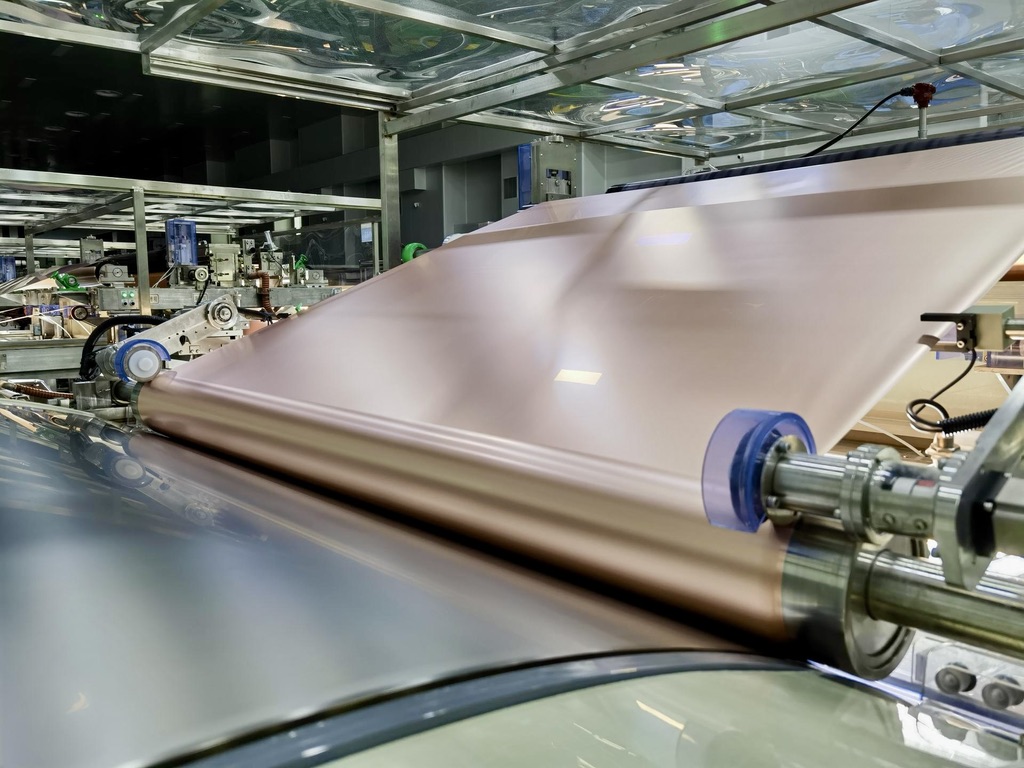
When battery teams compare copper foil, tensile strength often gets attention first. That is understandable. Thin foil must survive production tension, calendering pressure, slitting, winding, and handling. But strength alone is not enough. A foil that is strong but brittle can fracture. A foil that elongates but lacks strength can deform, wrinkle, or stretch outside the process window.
Battery copper foil needs strength and elongation designed together. This is especially important for ultra-thin gauges, large-format electrodes, cylindrical winding, high-speed coating, and anode systems that experience meaningful expansion and contraction.
The Buyer Problem: Thin Foil Must Run
Cell manufacturers want thinner foil because it can reduce inactive current collector mass and help improve energy density. Production teams want that thinner foil to behave like a stable web. Those goals can conflict.
During coating, the foil must remain flat and stable under line tension. During drying, it sees heat and mechanical stress. During calendering, the electrode is compressed. During slitting, edge quality and fracture resistance matter. During winding or stacking, the foil has to handle bending and alignment without cracking, folding, or creating defects.
If tensile strength is too low, the foil may stretch, neck, tear, or create dimensional instability. If elongation is too low, the foil may not tolerate localized stress. If heat exposure weakens the material, a good incoming number may not predict production performance. This is why the mechanical property profile should be evaluated as a system.
What Tensile Strength Tells You
Tensile strength describes the stress a foil can withstand before failure under a defined test condition. For battery production, higher tensile strength can help protect the web during coating, drying, calendering, slitting, and winding.
Xenith’s product specification table lists standard-strength, medium-strength, high-strength, and ultra-strength categories for selected gauges. For 4-6 µm products, the ultra-strength category is listed as ≥600 MPa, while other tensile categories include standard strength at ≥300 MPa, medium strength at 400-450 MPa, and high strength at 500-550 MPa. The site also highlights high-strength BCF above 600 MPa for stable electrode processing.
For cell manufacturers, the important detail is not the biggest number on the page. It is whether the strength applies to the exact thickness, roll format, and thermal history needed for the program. Tensile data should be reviewed by gauge and grade, and then confirmed through coating and handling trials.
What Elongation Tells You
Elongation describes how much the foil can stretch before breaking under a defined test. It gives insight into ductility. In electrode manufacturing, ductility helps the foil survive bending, winding, local stress, and repeated handling without brittle fracture.
Xenith’s public product page states high elongation above 15% for handling reliability, while the specification table gives minimum elongation values by listed gauge. These two views serve different purposes. The product page communicates capability. The table gives baseline specification values for the listed products. A customer qualification process should confirm the exact grade, gauge, and condition being evaluated.
Elongation is particularly important in cylindrical cell winding and in electrodes that experience mechanical stress during cycling. As anodes move toward higher capacity materials, the current collector may need to tolerate more interface stress. The foil does not solve every expansion problem, but insufficient ductility can make the electrode less forgiving.
Heat Exposure Changes The Question
Battery copper foil is not used only at room temperature. It goes through drying and may experience thermal conditions during electrode processing and storage. Mechanical properties after heat exposure can matter as much as incoming properties.
A foil that softens, loses strength, or changes dimension after thermal exposure can create wrinkles, deformation, or coating defects. A supplier evaluation should therefore include heat resistance or property retention data relevant to the customer’s process.
Xenith’s specification table includes oxidation resistance at 140℃ for 15 minutes without oxidation or discoloration, and lists a constant temperature oven among its inspection equipment. That published information supports discussion of heat-related evaluation, though customer-specific process validation should still be performed for actual drying and calendering conditions.
Why Strength Without Elongation Can Fail
A strong but low-ductility foil may look attractive on a data sheet. In practice, it can be vulnerable to brittle cracking or tearing when local stress is concentrated. Slitting edges, winding tension, wrinkles, or particles can all create stress points. If the foil has little ability to deform, small defects can become breaks.
This problem becomes more serious as foil gets thinner. Ultra-thin foil has less cross-section to absorb damage. The safety margin depends on both strength and ductility, plus flatness, edge quality, and roll handling. Battery manufacturers should therefore avoid ranking suppliers by tensile strength alone.
Why Elongation Without Strength Can Fail
The opposite problem is also real. A ductile foil that lacks enough tensile strength may stretch, deform, or become unstable under web tension. It may run inconsistently through coating equipment, respond poorly to calendering, or create dimensional variation. Too much deformation can affect electrode alignment and handling.
This is why mechanical balance matters. The foil has to be strong enough to resist production stress and ductile enough to tolerate unavoidable strain. The useful operating window depends on the customer’s line design, process speed, roll format, and electrode architecture.
What Cell Manufacturers Should Ask
During supplier qualification, process and quality teams should ask for tensile strength and elongation by gauge and grade. They should ask whether measurements are machine direction, transverse direction, or both where relevant. They should ask about heat exposure, lot-to-lot variation, and the supplier’s inspection method.
They should also run practical trials. Does the foil wrinkle during coating or drying? Does it break under expected line tension? Does it deform after calendering? Does slitting produce clean edges? Does winding remain stable? Does the electrode show signs of cracking, delamination, or poor alignment?
Xenith’s Position In This Discussion
Xenith’s strongest published proof points are aligned with this strength-plus-elongation requirement. The site presents 3.5-12 µm BCF, high-strength options above 600 MPa, elongation above 15%, custom roll dimensions, and inspection support. The company also points to 20+ years of copper foil R&D and production experience from its core team.
Those claims matter because they address the practical problem: thin foil must run. Still, every customer program should confirm fit through its own coating, calendering, slitting, winding, and cell validation steps. Mechanical performance is not a brochure claim; it is a production behavior.
The Practical Message
Battery copper foil should be engineered for the process, not just the data sheet. High tensile strength helps protect thin foil from breakage and deformation. Elongation helps it absorb strain without brittle failure. Thermal stability, flatness, edge quality, and roll consistency complete the picture.
For cell manufacturers, the best copper foil is not simply the strongest or the thinnest. It is the foil that delivers the right mechanical balance for the target cell design and runs reliably through the electrode line.
Ready to evaluate BCF for your battery line?
Review Xenith’s copper foil specifications or share your target thickness, roll format, application, and sample requirements with our team.