
July 12, 2024
Copper Foil Surface Roughness, Anode Adhesion, and Contact Resistance
Copper foil surface morphology can affect slurry wetting, coating uniformity, anode adhesion, contact resistance, and long-term electrode stability.
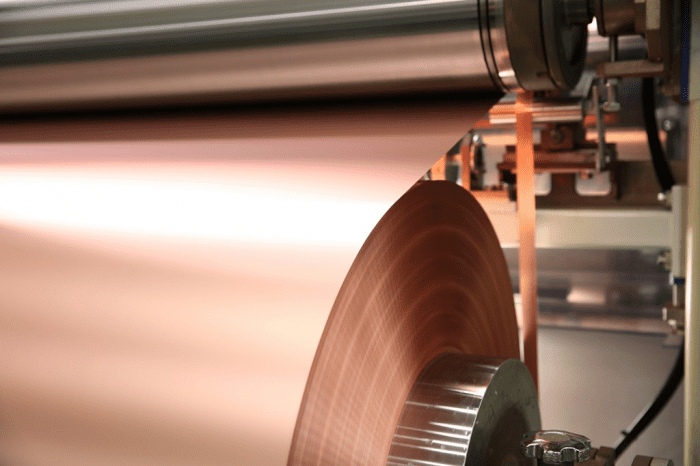
Copper foil surface roughness is sometimes treated as a simple specification. In battery manufacturing, it is more useful to treat it as an interface design question. The anode coating has to wet the foil, adhere to it, maintain electrical contact, tolerate calendering, and remain stable through cycling. Surface morphology helps shape all of those behaviors.
The right surface is not universally rough or universally smooth. It depends on the active material, binder, slurry rheology, solvent system, coating method, calendering pressure, electrolyte environment, and performance target. For cell manufacturers, the goal is to select a foil surface that supports the electrode process rather than creating a hidden source of variation.
The Buyer Problem: The Interface Must Stay Reliable
An anode current collector has two jobs at the interface. It must provide electrical connection, and it must support the active material layer mechanically. If slurry wetting is poor, coating uniformity can suffer. If adhesion is weak, the electrode can delaminate or isolate active material. If contact resistance is high or inconsistent, cell resistance and heat generation can become harder to manage.
These problems are not only laboratory concerns. They affect production yield, formation behavior, fast-charge capability, cycle life, and quality consistency. A copper foil surface that looks acceptable in incoming inspection may still perform poorly with a specific customer slurry.
That is why process engineers and R&D teams should evaluate roughness together with wettability, coating quality, adhesion, and resistance, not as a single number removed from the electrode system.
What Roughness Metrics Can And Cannot Tell You
Common copper foil roughness values include Ra and Rz, often measured separately on shiny and matte sides. These metrics help describe surface profile, but they do not fully define the interface. Two foils with similar roughness numbers can behave differently if their surface chemistry, peak shape, cleanliness, oxidation state, or treatment differs.
Xenith’s published specification table lists shiny surface Ra at ≤0.43 µm and matte surface Rz at 2±1 µm for the listed gauges. It also includes wettability at ≥38 mN/m. These values give battery teams a starting point for technical comparison, but the real qualification question is whether those surfaces work with the customer’s electrode recipe and process window.
Roughness should therefore be evaluated with application tests: contact angle or wetting behavior, coating uniformity, peel strength, surface microscopy, resistance measurements, and cycling results where needed.
Wettability And Coating Uniformity
Slurry coating is a manufacturing process before it is an electrochemical system. The foil surface has to accept the slurry consistently across the roll width and along the roll length. Poor wetting can contribute to coating streaks, voids, pinholes, uneven loading, or edge instability.
Wettability is influenced by surface energy, roughness, cleanliness, oxidation, and contamination. A foil that has oil stains, oxide patches, particles, or inconsistent surface treatment can create local coating problems. This is why surface condition and appearance requirements matter.
Xenith’s appearance criteria call for smooth and flat foil, uniform color, no oxidation, spots, corrosion, or oil stains, and neat edges with no burrs or copper dust. For cell manufacturers, these are not cosmetic details. They help protect coating stability and reduce the risk that defects move downstream into electrode and cell assembly.
Adhesion Between Anode Coating And Foil
Adhesion depends on more than the foil, but the foil is central. Binder chemistry, active material particle shape, conductive additives, slurry solids, drying profile, calendering pressure, and electrolyte exposure all contribute. The copper foil surface provides the foundation.
A surface that is too smooth for a given system may reduce mechanical anchoring. A surface that is too rough or irregular may increase local defects, coating nonuniformity, or contact issues. The best surface is the one that gives stable adhesion without introducing unnecessary resistance or process difficulty.
For graphite anodes, a supplier may focus on consistent wetting and coating stability. For silicon-containing anodes, the interface may see higher expansion and contraction stress, making adhesion and mechanical resilience more important. For high-rate cells, the contact between the coating and current collector becomes part of the resistance and heat-generation discussion.
Contact Resistance And High-Rate Performance
Fast charging and high-power operation make every resistance contribution more visible. Copper itself is highly conductive, but the electrode interface still matters. If the coating does not maintain uniform contact with the current collector, current distribution can become uneven and impedance growth can become harder to control.
Surface morphology can influence contact area and interface stability. Surface treatment can improve adhesion in some systems, but it must be compatible with the customer’s chemistry. A supplier should not claim that one surface design is best for every anode. The right approach is controlled, documented, application-specific surface design and validation.
How Cell Manufacturers Should Qualify Surface Design
The qualification process should begin with the customer’s coating process. R&D and process teams should test the foil with the actual slurry or a representative slurry, under representative coating speed, drying profile, and calendering pressure.
They should inspect wetting behavior, coating appearance, loading uniformity, peel strength before and after calendering, interface resistance, and any changes after storage or electrolyte exposure. If the cell platform requires fast charging or long cycle life, cell-level testing should be used to confirm that interface behavior remains stable.
Quality teams should ask how roughness is measured, how often it is inspected, whether the supplier controls both sides of the foil, and how lot-to-lot consistency is documented. If multiple surface options exist, the supplier should explain the intended process fit for each option.
Xenith’s Relevant Capability
Xenith publishes surface roughness, wettability, appearance, oxidation resistance, and chemical composition in its product specification table. The company also lists inspection equipment including a surface roughness tester, scanning electron microscope, spectrophotometer, direct-reading spectrometer, and Leica microscope. These tools are relevant to surface evaluation because they support measurement, inspection, and customer discussion around foil condition.
The site does not need to overclaim customer-specific adhesion or resistance outcomes. The stronger message is that surface properties are measurable, documented, and important to qualification. Customer trials can then connect those properties to coating behavior and cell performance.
The Practical Message
Copper foil surface roughness is not a commodity checkbox. It is part of the anode interface. It can influence slurry wetting, coating uniformity, adhesion, resistance, and long-term stability.
For cell manufacturers, the best supplier conversation is specific: what anode chemistry, binder system, coating process, calendering pressure, and performance target is the foil supporting? Once that context is clear, roughness data becomes useful. Without it, the number alone is incomplete.
Ready to evaluate BCF for your battery line?
Review Xenith’s copper foil specifications or share your target thickness, roll format, application, and sample requirements with our team.